














Transaction Center
Time to bring it home. Find zipForm®, transaction tools, and all the closing resources you'll need. Except for the champagne — that's on you.
Easily renew your real estate license with the FREE 45 hour online license renewal package from C.A.R.
Distinguish yourself by learning how to build a business that specializes in niche markets to nearly double your earning potential in various real estate sectors
Browse our class schedule to find when and where to take real estate courses.
Classes by Topic Online BundlesPrepare to earn your real estate license with our online courses. Get your California real estate license with OnlineEd. Price match guarantee. Mobile friendly. DRE-approved. Instructor Support. Start immediately!
Complete your eight-hour NMLS license renewal requirement through our NMLS-approved provider, OnlineEd
The main Business Meetings page provides key links for Directors and Committee Members. The next C.A.R. Business Meeting is scheduled for October 6-9, 2026 in Long Beach.
REimagine!® Real Estate Conference & Expo is where learning takes center stage and where business solutions and connections are at the forefront of the real estate industry.
Learn how to schedule a C.A.R. outreach speaker for your next event and access presentations from previous outreaches.
A one-stop shop for tools and and resources to educate consumers about the intricacies of buying and selling a home and how a REALTOR® can help.
Down Payment Resource Directory Infographics Tax Reform One SheetsExplore and interact with the latest market statistics.
County Housing Market Summaries County Market Updates Impact of L.A. Wildfires Market at a GlanceThis information is designed for Real Estate Brokers and Office Managers to assist you in supporting your real estate business.
Resources to help you stay informed about the evolving role of artificial intelligence in real estate
Discover homeowner insurance resources from C.A.R. to help navigate California's wildfire-related insurance crisis. Access expert-led webinars, podcasts, and support tools for both REALTORS® and consumers seeking guidance on maintaining or finding coverage.
We provide information and resources to support Real Estate Team Leaders in navigating their roles and ensuring compliance.
CCRE's mission is to advance industry knowledge and innovation with an emphasis on convening key experts and influence-makers.
From webinars to videos and podcasts to blogs, C.A.R. keeps you in the know.
Videos Webinars PodcastsC.A.R. publishes various newsletters throughout the year. Formerly, C.A.R. also published a magazine, for which past issues are still available.


C.A.R. is undertaking its first comprehensive review of governance in more than 30 years. Identified as a priority in C.A.R.'s Strategic Plan, the review is intended to ensure the organization's structure, decision-making processes, and member engagement opportunities continue to support C.A.R.’s mission and long-term success.
A 15-member Governance Review Task Force is leading this work with support from Slalom, a consulting partner. Since the Board of Directors approved the review at the Spring Business Meetings, the Task Force has been assessing C.A.R.’s current governance structure and gathering input from members, Directors, brokers, local association leaders, and other stakeholders to inform its discussions and recommendations.
This page serves as the central resource for updates, key milestones, background information, and opportunities to stay informed and engaged.
Questions, comments, and feedback are welcome and may be submitted to [email protected].
Materials and Resources
Governance Recommendations At-a-Glance
Start here for a quick overview.
A concise summary of the Governance Review, the three Phase 1 recommendations presented at the Fall Business Meeting, and what happens next.
Task Force Interim Report
A comprehensive summary of the Task Force’s work to date, including its approach, member engagement, current-state findings, recommendations and rationale.
Governance Review Master Presentation
The Task Force has published its initial recommendations and supporting materials for member review. This is the complete research and recommendations deck, including the data and analysis underlying the Governance Review, detailed Board allocation information, current-state findings, member research and survey results, and other governance concepts considered. The proposed Phase 1 recommendations focus on Board of Directors composition, Director qualifications, and Executive Committee design, with the goal of creating a more effective and inclusive governance structure.
Director Allocation Tool
See how the proposed Board allocation formula would impact your local association. Enter your AOR to compare its current Director allocation with the proposed model and explore the underlying membership and seat data.
All-Director Pre-Meeting Briefing
Latest Updates
Task Force Recommendations
View the latest Governance Review presentation, shared with the Executive Committee and SPF Committee on September 10, outlining the Task Force’s current recommendations. The Task Force continues to meet and consider feedback ahead of Long Beach. Check back for key milestones, FAQs and meeting recordings.
September 10, 2026
Task Force Co-Chairs Jennifer Branchini and Erin Stumpf tackle additional questions submitted during the Special Director Town Hall, providing further context and insight on key topics being explored as part of the Governance Review.
August 31, 2026
Special Director Town Hall: Governance Review Update
C.A.R. Directors heard from Governance Review Task Force leadership on progress to date, key stakeholder themes, and areas under consideration, followed by Q&A and feedback.
August 31, 2026
Governance Review Video Update
Task Force Co-Chairs Jennifer Branchini and Erin Stumpf share an update on the work underway, what the Task Force is hearing and learning, and what to expect in the months ahead.
August 14, 2026
Why Governance Review, Why Now?
As C.A.R. advances the priorities outlined in its Strategic Plan, this review provides an opportunity to evaluate how the organization’s governance structure can best support effective decision-making, meaningful member engagement, and long-term success. It is also an important opportunity to take a fresh look at whether the current structure is well-positioned to meet the evolving needs of the organization, its members, and its volunteer leaders.

CHANGING NEEDS
C.A.R. continues to evolve, and its governance structure should continue to support the changing needs of members, volunteer leaders, and the organization.

EFFECTIVE DECISION-MAKING
Strong governance helps ensure decisions are thoughtful, timely, and supported by clear roles, responsibilities, and processes.

MEANINGFUL ENGAGEMENT
Meaningful opportunities for members to participate, share their perspectives, and contribute to the organization’s direction strengthen C.A.R. and its leadership.

PREPARING FOR THE FUTURE
A governance review helps ensure C.A.R. remains adaptable, responsive, and well-positioned for long-term success.
How Would the Proposed Changes to Board Size Impact my AOR?
Look up what the impact would be on your local association under the proposed C.A.R. governance reform model. By selecting your organization from among California’s 95 local AORs, you can instantly compare your current Local AOR–selected director seat allocation against the proposed entitlement based on April 1, 2026 membership counts. Please note that these figures reflect the total number of local director seats each association is entitled to allocate—isolated from regional chairs, committee leaders, and statewide officer positions—giving local leaders an apples-to-apples look at how representation would shift under the new formula.
SEAT ALLOCATION
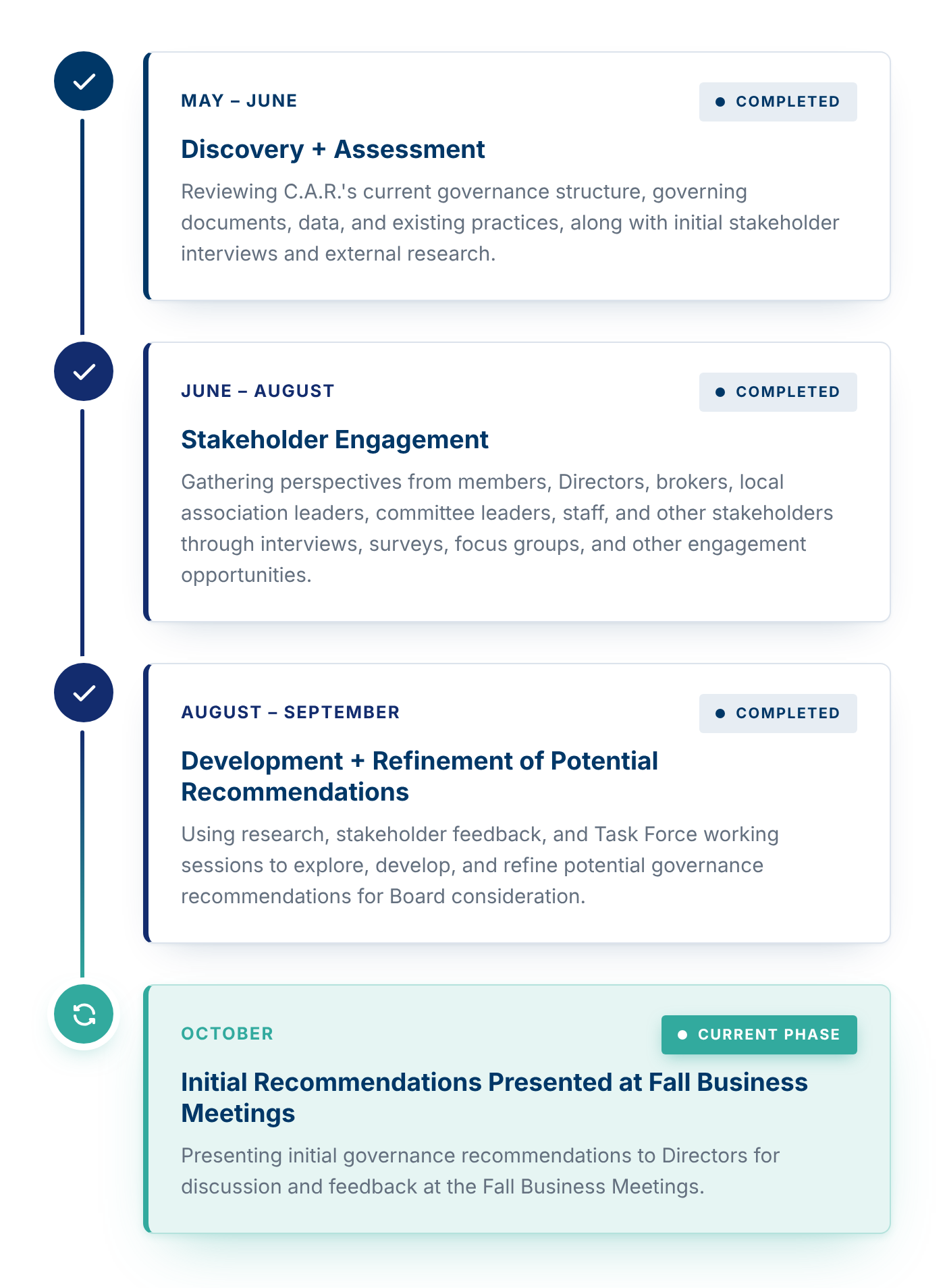
Governance Review Timeline
The timeline below highlights the key stages of the Governance Review and where the work stands today.
Frequently Asked Questions
GOVERNANCE STRUCTURE & REPRESENTATION
C.A.R.’s Board currently includes more than 800 Directors, making it one of the largest governing bodies of its kind. Research and stakeholder feedback have raised questions about whether a Board of this size can consistently support focused discussion, active participation, and effective decision-making. In member focus groups, 48.6% of members agreed that the current size of the Board makes it difficult to govern effectively.
Because of this feedback, the Task Force is exploring potential options to reduce the size of the Board. Because more than two-thirds of the Board is comprised of Directors appointed by local associations, Director allocation is a key part of that discussion.
Members have also emphasized the importance of representation and ensuring local associations have a meaningful voice. The Task Force is evaluating whether changes to Board size and composition can improve effectiveness while preserving strong representation across C.A.R.’s membership.
The Task Force discussed numerous allocation models – including variations on proportional representation, equal representation, and regionally-allocated seats. We then narrowed down to four allocation approaches, ranging from modest right-sizing to a more significant reduction. These approaches were tested with members in focus groups and surveys, where we learned that most members favored a reduction in Board size over the current state.
Ultimately, the Task Force’s recommendation reduces the projected Board from 821 to about 511, or about 21% below current average meeting attendance of roughly 650. The Task Force viewed this as a meaningful reduction that improves the Board’s ability to deliberate and make decisions, retains proportional local representation while ensuring every association keeps at least one Director, and meaningfully reduces estimated local association travel costs (by ~$1.5 million annually).
The Task Force felt a more modest reduction would not have achieved the goal in the strategic plan to create a more nimble governing body, while a larger reduction could be too significant a change for the organization to take on in the near-term. The Task Force proposes reviewing the formula on a recurring cycle aligned to future Strategic Plan development to ensure it continues to align with and advance C.A.R.’s Strategic Plan, mission, and vision.
Every local association will retain at least one guaranteed State Director, ensuring all 95 associations continue to have a direct voice on the Board. Small associations currently represent approximately 10% of C.A.R. membership. The current Bylaws formula allocated ~18% of State Director seats to small associations (150 out of 825). The proposed model would move their share of allocated seats to ~20%—still providing representation above their share of statewide membership while creating greater proportionality across associations of all sizes.
Importantly, Board representation and committee participation are separate. Members do not need to be State Directors to serve on most C.A.R. committees, so reducing an association's number of Board seats does not limit the number of members it can put forward for committee service. C.A.R. will also evaluate committee assignments and the selection process to ensure members from associations of all sizes continue to have meaningful opportunities to participate.
Participation is an important part of the discussion. C.A.R. currently makes more Board seats available than are consistently filled by local associations. Of filled seats, attendance and voting participation at Board meetings is approximately 80%. Participation rates are generally consistent across the Directorship, regardless of the size of the local association represented.
The Task Force is considering these factors alongside member feedback that having prepared, engaged Directors is more important than simply maximizing the number of Board seats.
The Task Force has explored a range of approaches to representation. At this stage, the Task Force has focused on models that preserve allocation based on local associations. However, no final model has been selected, and member feedback is helping inform which approaches warrant further consideration.
C.A.R. has a larger Board relative to its membership than the peer and professional associations reviewed. With 821 Directors serving approximately 179,000 members, C.A.R. has roughly one Director for every 218 members.
By comparison, the National Association of REALTORS® has approximately one Director for every 1,392 members, while other large State REALTORS® have one director for every 250 to 500 members. Many state and local associations are also conducting governance reviews that may result in smaller governing bodies in the coming years.
Other large professional associations reviewed, including the American Bar Association, American Medical Association, and American Chemical Society, operate representative bodies with significantly higher member-to-representative ratios. While there is no single “right” Board size or governance model, these comparisons suggest there may be an opportunity for C.A.R. to reduce Board size while maintaining substantial member representation. .
DIVERSITY, INCLUSION & LEADERSHIP DEVELOPMENT
Maintaining diverse perspectives is an important consideration in evaluating any future governance model. When selecting Stakeholder Councils to provide input as part of this review process, C.A.R. intentionally designed groups to reflect the broad diversity of the organization, including differences in geography/region, association size, professional experience, demographics, and leadership experience.
The review is considering both who serves in governance and how members develop into future leadership roles. Stakeholders have consistently called for clearer leadership pathways, more transparent expectations, stronger onboarding and preparation, and greater consistency in how members are selected for governance positions. Any future structure will need to preserve meaningful opportunities for members to become involved while also helping ensure they are prepared to succeed when they take on leadership roles.
Yes. The review intentionally included a broad range of perspectives across regions, association sizes, professional roles, demographics, governance experience, and leadership backgrounds. The Task Force considered the risk that a smaller Board could narrow leadership pathways if not designed carefully. The proposed qualifications create several pathways into service, including local, state, NAR, MLS, civic, and industry leadership experience. The intent is to raise readiness while preserving multiple ways for qualified members, including emerging leaders, to participate.
Member input has been intentionally built into the process. There have been two rounds of focus groups with nine stakeholder councils across different member and leadership segments (160+ invited to participate) and an all-member member survey designed to reach members regardless of their prior involvement in governance (1800+ responses). Participants have represented different parts of California, association sizes, professional roles, levels of governance experience, and leadership backgrounds. In addition, C.A.R. has set up a landing page where members can learn more about the governance review process, and an email address ([email protected]) where any member can provide feedback or ask questions.
DIRECTORS-FOR-LIFE & BOARD COMPOSITION
The proposal does not take anything away from current Directors-for-Life. Everyone who currently holds that status would keep both the title and voting authority.
Going forward, C.A.R. would no longer make new Director-for-Life appointments. Long-serving members would continue to be recognized through a reimagined, combined honorary recognition with the CDRA award, but that recognition would not include a lifetime voting seat on the Board. This approach preserves recognition for exceptional service while supporting a more active Board.
The proposal would also extend the existing Director attendance requirement to Directors-for-Life: two consecutive unexcused absences from Board meetings would result in loss of voting authority.
Those 257 directors include: Elected Officers, Past Presidents, Directors-at-Large, NAR Directors from CA, Committee & Forum Chairs, Executive Committee Members, Directors-for-Life, Regional Chairs, and Immediate Past Regional Chairs .
These roles have their own appointment processes that are separate from the seats allocated to local associations based on the Bylaws formula. The 257 count is based on the 2026 Board roster and that number may fluctuate slightly year over year.
The proposals put forward by the Task Force would impact these roles in two ways. Immediate Retiring Regional Chairs would be removed from this count, and no new Director-for-Life appointments would be made. Current Directors-for-Life would retain their status, and C.A.R. would re-imagine the CDRA award to honor long-standing Directors.
Delegates are synonymous with what we typically call State Directors. Under California law, they exercise the voting rights of the Association’s membership. They are appointed by local associations, with Delegate seats allocated under a Bylaws-based formula tied to membership size.
Delegates/State Directors participate in Board meetings alongside other Directors, but they hold a distinct legal role: they exercise the membership vote on matters reserved to the membership. Under the Bylaws, Delegates only – not the full Board – vote on amendments to the Articles of Incorporation and on the re-approval of Directors-for-Life and Past Presidents every 4 years.
Not all Directors are Delegates. 257 Directors serve on the Board by virtue of filling one of the following roles: Elected Officers, Past Presidents, Directors-at-Large, Directors-for-Life, NAR Directors from California, Committee and Forum Chairs, Executive Committee members, Regional Chairs, and Immediate Retiring Regional Chairs. A local association might choose to also assign these members as a Delegate/State Director, but they do not have to.
The Task Force is reviewing Board composition as a whole, including both locally appointed Directors and other positions that receive Board seats through C.A.R. leadership, regional, committee, or legacy roles. Some specific positions are being examined, for example, Directors-for-Life and automatic seats for Immediate Past Regional Chairs. The broader objective is to ensure Board seats have a clear purpose and contribute to effective, representative governance.
DIRECTOR SERVICE & PARTICIPATION
Yes. One concept being tested is establishing more consistent baseline qualifications for all C.A.R. Directors. Areas under consideration include adding a requirement that Directors are actively practicing real estate in California, with the Task Force collecting feedback on what specifically should be included in the definition of “actively practicing”. In addition, the Task Force is exploring whether a prior experience requirement should be added and what should qualify as prior experience (e.g., prior C.A.R. committee membership, local leadership, etc.)
Local associations would be responsible for confirming that the individuals they appoint meet the new Director requirements. The intent is to keep the process practical and rely primarily on an honor system rather than create a burdensome compliance process. Details would be developed as part of implementation.
Director attendance and participation were reviewed as part of the current-state assessment. The data shows that not all Board seats available to local associations are currently being filled, and overall voting participation is approximately 80%. These findings are being considered alongside other factors as the Task Force evaluates Board size, composition, and how to support meaningful participation in C.A.R. governance.
RESEARCH, DATA & STAKEHOLDER INPUT
The Governance Review has drawn on multiple sources, including a review of C.A.R.’s bylaws and governance materials, analysis of membership and Board data, interviews with governance leaders and staff, and research into governance practices at other REALTOR® and member-based organizations. Member input has also been intentionally built into the process. C.A.R. conducted two rounds of focus groups with nine Stakeholder Councils representing different member and leadership segments and launched an all-member survey that received more than 1,800 responses. Participants have represented different parts of California, association sizes, professional roles, levels of governance experience, and leadership backgrounds.
To date, ~100 members have participated in focus groups or interviews (out of ~160 invited). A survey sent to the entire C.A.R. membership received ~1800 responses, with respondents from across all 95 local associations.
The survey received approximately 1,840 responses, representing about 1% of C.A.R. membership. Respondents came from associations of all sizes: 13.8% from small associations, 43.7% from medium associations, and 29.9% from large associations. An additional 12.5% did not indicate their association size.
Participation also reflected a range of governance experience. 15.1% of respondents currently serve on a C.A.R. governance body, 4.2% served within the last five years, 7.5% served more than five years ago, and 73.2% have never served in a governance role.
The survey also captured input from a diverse cross-section of member segments, including sales agents (55.0%), broker owners (26.9%), broker associates (18.9%), property managers (7.5%), real estate professionals (2.9%), leasing professionals (2.9%), REALTOR® AEs/CEOs (2.6%), and other respondents (6.0%).
GOVERNANCE OPERATIONS & FUTURE STRUCTURE
All aspects of C.A.R.’s structure are being evaluated, including Board composition, regional structure, leadership qualifications, committee structure, meeting design, decision-making pathways, governance clarity, and leadership development. Not every area will necessarily result in a structural recommendation. Some may be addressed through operational improvements or implementation activities.
Yes. The Task Force considered committee and forum structure as part of the broader governance review. In focus groups, members identified opportunities to clarify purpose, reduce duplication, right-size participation, and modernize how committee work is conducted. However, members generally viewed Board composition and Director qualifications as higher priorities, so the Task Force is not proposing specific committee or forum reforms in the first phase. We will reconsider committee and forum reforms in 2027 based on the outcomes of the Phase 1 proposals.
The Task Force considered potential regional changes, including redrawing the map, setting minimum thresholds, and rotating Regional Chair appointments. However, regional structure is closely tied to Board composition and the number of Directors serving in each region. Before making significant changes to regions, the Task Force believes it is important to finalize and understand the impact of Phase 1 reforms. That will allow a more informed conversation about regional structure and the appropriate number of members and Directors per region.
TIMELINE & NEXT STEPS
C.A.R.’s focus on governance has been several years in the making. In 2021, C.A.R. appointed a Task Force to evaluate its mission and vision, and governance was subsequently identified as a priority in both the 2023–2025 Strategic Plan and the 2026–2028 Strategic Plan. In May 2026, the Board approved funding to bring on an external partner (Slalom) and formally move the governance review forward.
The current phase of work officially kicked off in June 2026. The Task Force is now using member feedback to determine which ideas should be advanced, refined, or removed from consideration. The current plan is to bring the Task Force’s recommendations to the Board for consideration at C.A.R.’s Fall Business Meeting.
Implementation planning will depend on which recommendations ultimately move forward and receive approval. The Task Force has heard consistently that significant governance changes should be thoughtfully communicated and phased where appropriate. Any approved changes would be accompanied by a transition plan addressing timing, governance documents, roles, communications, training, and other implementation needs.
Directors may be asked at the Fall Business Meeting to vote on whether to advance the recommendations, but that is separate from adopting them. No Bylaws vote will occur in Long Beach, as Bylaws amendments require a minimum of 30 days' advance notice to the Board.
Depending on feedback received during the Fall Business Meeting, the Task Force will determine whether to move forward with draft Bylaws changes, which the Board would vote on at the January 2027 Winter Business Meeting. This timing allows C.A.R. and local associations to incorporate the new requirements and processes into governance selections throughout 2027, with the updated governance structure taking full effect in 2028.
LOCAL ASSOCIATION QUESTIONS
Visit the Governance Review landing page for materials, updates, and FAQss.
Attend upcoming Office Hours week of September 28 to ask questions and share perspectives
Submit questions or feedback through the Governance Review email ([email protected])
Project Resources
Explore additional background and materials related to the Governance Review and C.A.R.’s governance structure.
Additional Governance Review resources and background materials will be added as they become available.
Questions or Feedback?
Member and stakeholder input remains an important part of the Governance Review process. Additional opportunities to learn more and provide feedback will be shared as the work progresses.
Questions, comments, and feedback may be submitted at any time to [email protected].